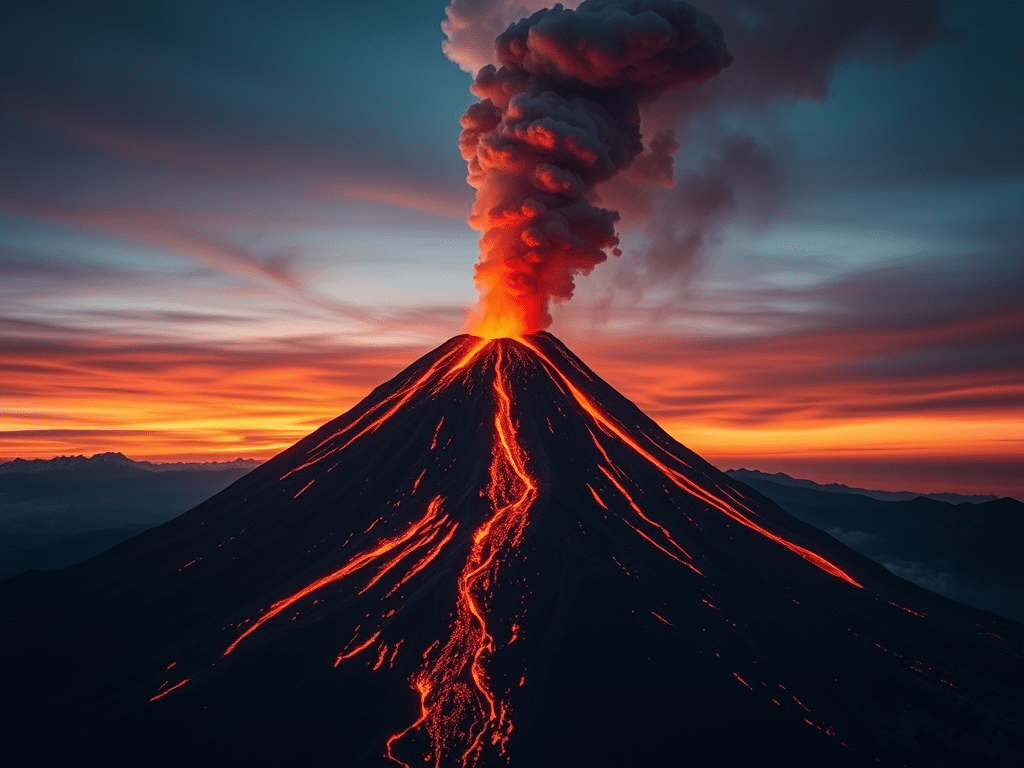
🌋Volcanoes: Earth’s Fiery Breath Beneath Our Feet
Volcanoes are among the most powerful and fascinating natural phenomena on our planet. They shape continents, influence climate, and remind us that beneath our seemingly stable ground, Earth is alive dynmaic. From quiet lava flows to explosive eruptions that can change global weather patterns, volcanoes play a critical role in our planets geological and ecological systems. But what exactly are they, how do they from, and why do they erupt? Let’s dive deep into the fiery world beneath our feet. Welcome to the Science story by GeoKnight’s.
What Is a Volcano ?
A volcano is essentially a rupture (explode, break, or tear) in the Earth’s crust through which magma, gases, and ash escape from the mantle to the surface. Magma is a mixture of molten rock, dissolved gases, and crystals formed in the Earth’s upper mantle and lower crust. When magma reaches the surface, it is called lava.
Volcanoes act like pressure valves for the Earth’s interior. The mantle, which lies beneath the crust, is hot enough to partially melt rocks, producing magma. Because magma is less dense than the surrounding solid rock, it rises through cracks and weaknesses in the crust. Over time, repeated eruptions can build up large volcanic mountains or in some cases, form entirely new islands in the ocean.
How Do Volcanoes Form ?
The Earth’s outer shell, the lithosphere, is divided into tectonic plates that float on the semi-fluid asthenosphere below. The movement of these plates is a key factor in the formation of volcanoes. There are three main tectonic settings where volcanic activity occurs:
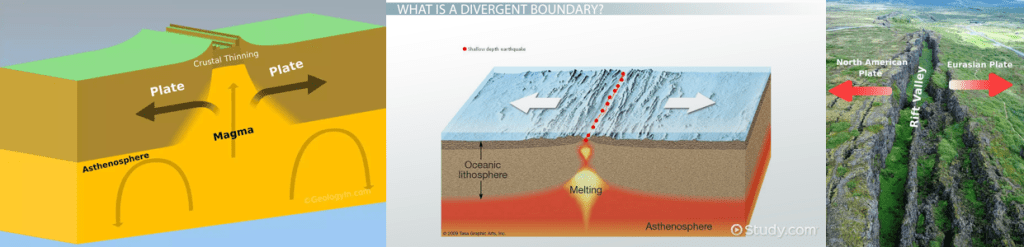
Divergent Plate Boundaries (Constructive): These are regions where plates are moving apart, such as the Mid-Atlantic Ridge. As the plates separate, magma rises to fill the gap, creating new crust. Most of this activity happens under the ocean.
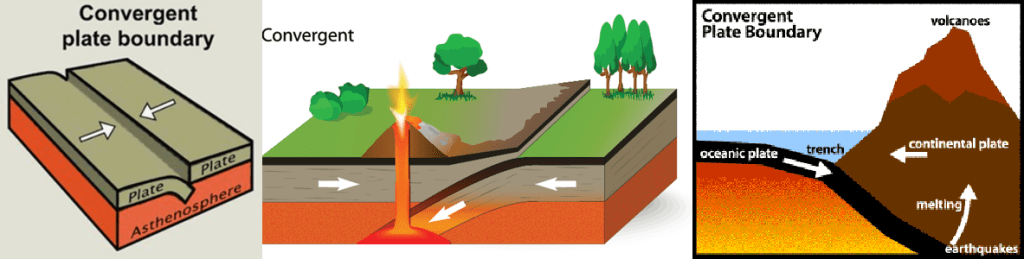
Convergent Plate Boundaries (Destructive): Here, plates collide, and one is forced beneath the other in a process called subduction. As the subducted plate sinks into the mantle, it melts and generates magma, which can rise to the surface and form volcanoes. The “Ring of Fire” around the Pacific Ocean is a prime example.
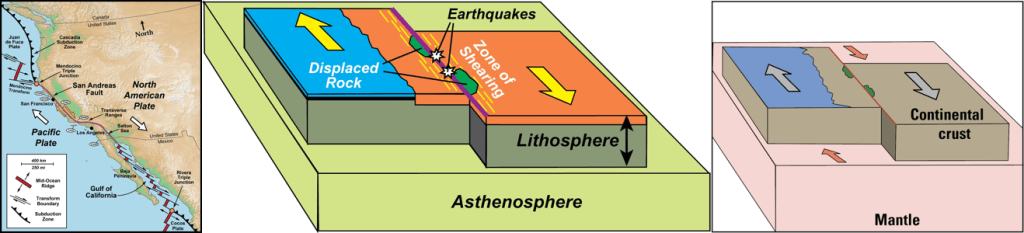
Transform boundaries (conservative): Transform boundaries are places where two tectonic plates slide past each other horizontally, rather than colliding or moving apart. Unlike divergent or convergent boundaries, they do not create or destroy crust instead, they cause intense friction and stress along the fault line. When this stress is suddenly released, it often results in earthquakes. A famous example is the San Andreas Fault in California, where the Pacific Plate and the North American Plate slide past one another.
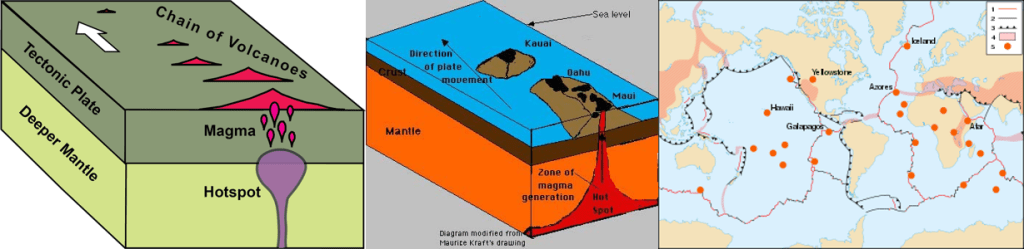
Hotspots: Some volcanoes form away from plate boundaries. These occur when a mantle plume, a column of hot rock, rises toward the surface. The Hawaiian Islands are formed by such a hotspot, with magma punching through the moving Pacific Plate over millions of years. These processes demonstrate how volcanism is directly linked to plate tectonics a fundamental driver of Earth’s geological evolution.
Why Do Volcanoes Erupt ?
Volcanic eruptions are driven by pressure. Magma beneath the surface contains dissolved gases, primarily water vapor (H₂O) carbon dioxide (CO₂) and sulfur dioxide (SO₂). As magma rises, pressure decreases, allowing these gases to expand much like opening a carbonated drink.
If the magma is fluid (low viscosity) the gases can escape gradually, leading to effusive eruptions where lava flows steadily, as seen in Hawaiian volcanoes. However, if the magma is thick and sticky (high viscosity), gases become trapped, pressure builds up, and eventually results in a violent explosive eruption. These can produce ash columns that reach the stratosphere, pyroclastic flows, and widespread destruction, like the eruption of Mount Vesuvius or Mount St. Helens.
The composition of magma (basaltic, andesitic, or rhyolitic) plays a major role in the eruption style. More silica-rich magmas (like rhyolite) are more viscous and explosive while basaltic magmas are typically less viscous and erupt and erupt more gently.
Types of Volcanoes
Volcanoes come in different shapes and behaviors depending on their eruption history and magma composition. The main types are:
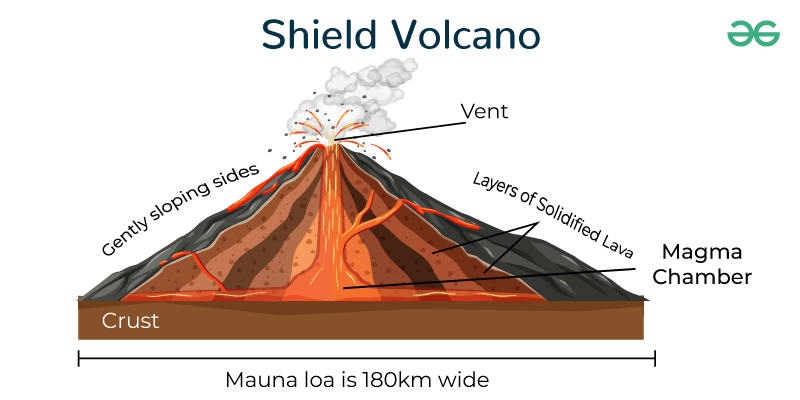
Shield Volcanoes: Broad, gently sloping volcanoes formed by low-viscosity basaltic lava that can travel long distances. Example: Mauna Loa in Hawaii.
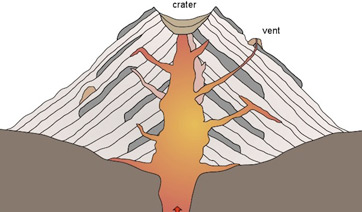
Stratovolcanoes (Composite Volcanoes): Tall, conical volcanoes made of alternating layers of lava and ash. They often produce explosive eruptions. Example: Mount Fuji, Mount Vesuvius.
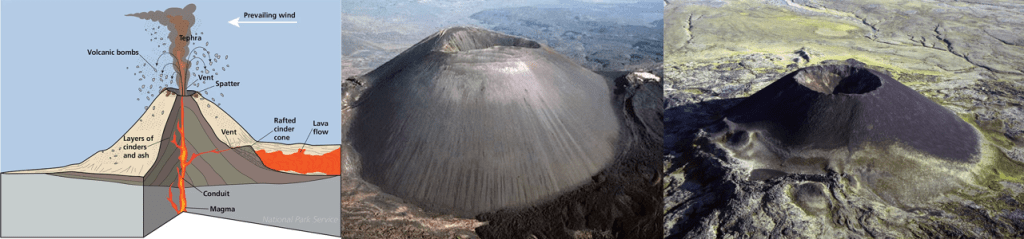
Cinder Cone Volcanoes: Small, steep-sided cones built from ejected lava fragments that solidify as they fall. These are usually short-lived features.
Calderas: Large, basin-like deoressions formed when a massive eruption causes the volcano to collapse into itself. Yellowstone is a famous example.

Each type represent different eruptive behaviors and geological histories, reflecting the diversity of volcanic on Earth.
Lava Types and Their Impact
Once magma reaches the surface, it becomes lava, and its characteristics affect the landscape and environment:
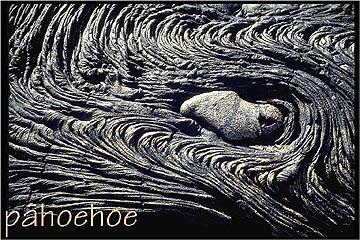
Pahoehoe Lava: Smooth , ropy lava that flows easily. It forms thin, glassy crusts.
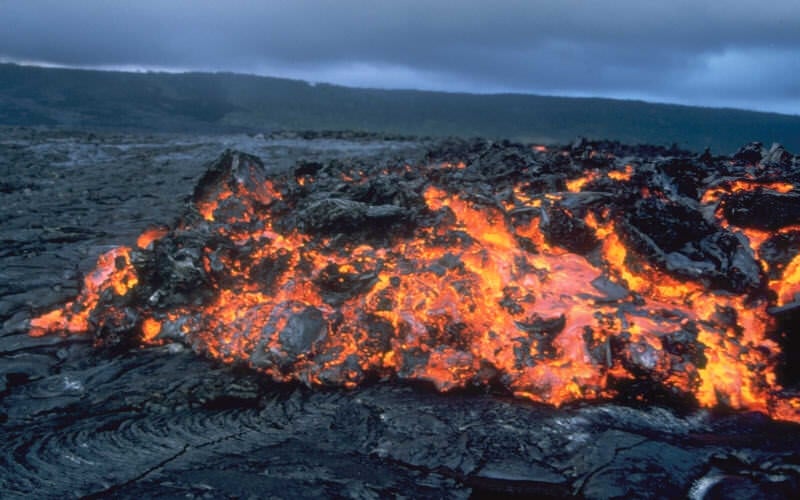
A’a Lava: Rough, jagged lava with a crumbly surface. It moves more slowly but can destroy structures in its path.
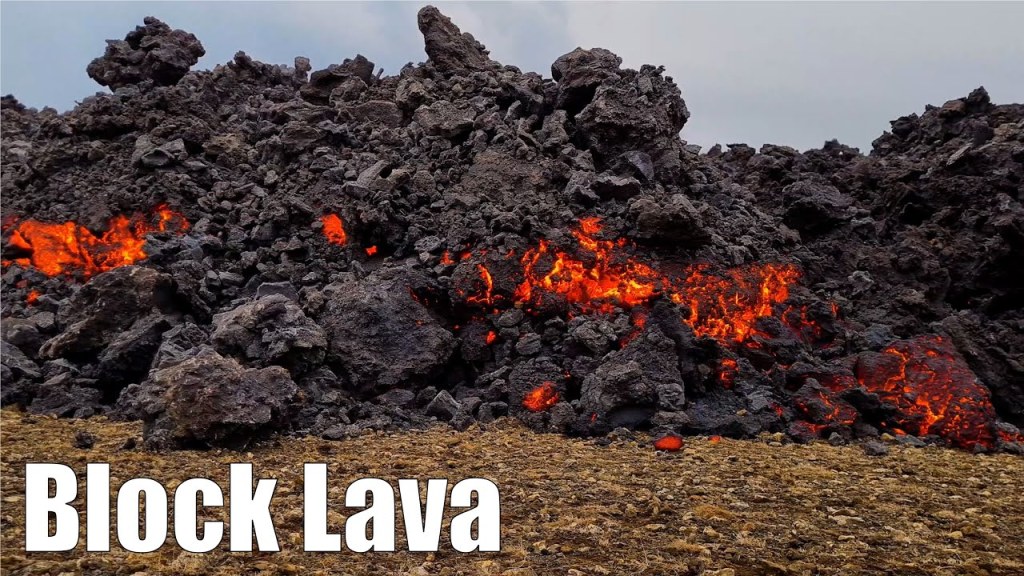
Blocky Lava: Thick, viscous lava that breaks into large blocks; usually associated with andesitic or rhyolitic compositons.
Beyond the surface flows, eruptions can emit huge amounts of volcanic ash and gases. These can block sunlight, lower global temperatures, and influence climate systems for years. The 1815 eruption of Mount Tambora, for instance, led to the “Year Without a Summer” in 1816.
Conclusion
Volcanoes are more than just fiery mountains. They are fundamental to shaping our planet. They create new land, recycle Earth’s interior, plate tectonics, and even planetary processes beyond our world. Next time you see a picture of a glowing lava flow or a towering ash plume, remember: you are looking at the Earth’s way of breathing, building, and evolving.
“Thank you for reading the science story. We look forward to seeing you in the next one. GeoKnights.”

 GEOKNIGHTS
Leave a comment